← Course materials

EN.553.211 · Fall 2026 · Zan Ahmad

Chapter 8: Hypothesis Testing

The notes retain the original introduction, Friday questions and solutions, followed by the completed chapter. The slide PDF has 90 pages; repeated reveals count as separate PDF pages.

Alpha, beta and power review

Main review: short exam cram · 2 pages

Detailed review: explanations and worked examples · 10 pages

Practice and worked solutions

Choose a topic below to move between the notes and slides. Page numbers refer to the PDF viewer. Page links work in supporting viewers; some mobile or embedded viewers open at page 1. If that happens, enter the page number shown here. The slides have a linked navigation strip above the original page; their content and page order are unchanged.

November 5 revision: notation follows the course slides; figures connect the equations to their meaning. Notes retain their existing page numbers. On a small screen, swipe a wide figure or open its full-size view.

Hypotheses, null distributions and p-values
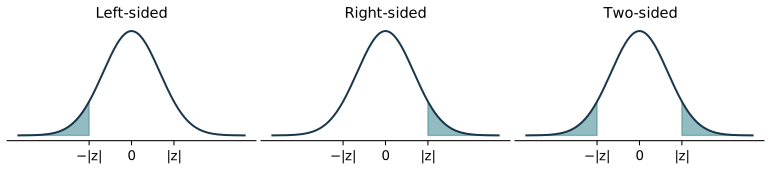
p-values shade outcomes at least as extreme as the observed statistic, in the direction specified before seeing the data.
The alternative selects the tail. p-values shade outcomes at least as extreme as the observed statistic, in the direction specified before seeing the data. Open full-size figure

Friday practice and solutions

Practice is additional course material. Related slides: GPA, pp. 20–30; one proportion, pp. 66–67; critical values, pp. 31–33.

Significance, critical values and rejection regions

Carpenter example: test, errors and power

Power and study design
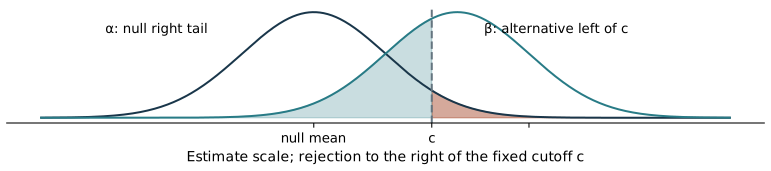
The cutoff stays fixed. Alpha is rejection probability under the null; beta is non-rejection probability under one specified alternative.
One rule, two distributions. The cutoff stays fixed. Alpha is rejection probability under the null; beta is non-rejection probability under one specified alternative. Open full-size figure

Two independent population means

Paired designs
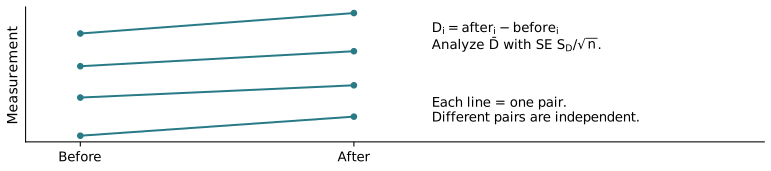
A shared baseline can vary greatly across individuals while each individual change is similar. Pairing retains that information.
Retain the matching. A shared baseline can vary greatly across individuals while each individual change is similar. Pairing retains that information. Open full-size figure

One proportion and the chip example

Fitness example and power curves

Two proportions and the heart-disease example
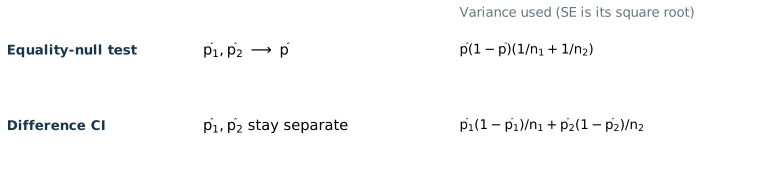
The common probability is estimated only when H0 imposes p1 = p2. A confidence interval for an unrestricted difference retains separate estimates.
The null determines pooling. The common probability is estimated only when H0 imposes p1 = p2. A confidence interval for an unrestricted difference retains separate estimates. Open full-size figure

Method selection and checks

Notes p. 31 is an additional Poisson-model connection, not a slide-deck example. The review draws across the chapter.
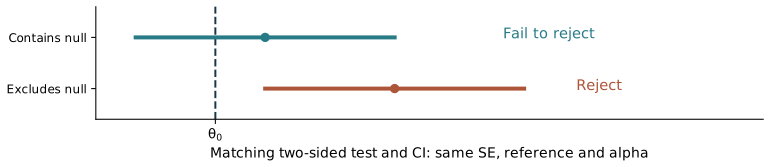
Excluding the null value and rejecting are equivalent only for matching procedures, not automatically for a pooled test and an unpooled CI.
Matching tests and intervals. Excluding the null value and rejecting are equivalent only for matching procedures, not automatically for a pooled test and an unpooled CI. Open full-size figure